
Confirmed relations
Versioned source-to-target edges, structural projections, value transformations, and qualifier-dependent mappings.
Products / ARI / Studio
Compile complex schemas into semantic shape graphs, infer candidate relations, and govern the results in one workspace.
The studio separates shape understanding from relation review without splitting them into disconnected tools. The Shape Graph Editor makes imported structures inspectable. The Relation Editor brings the source and target graphs together so reviewers can evaluate proposed edges in context.
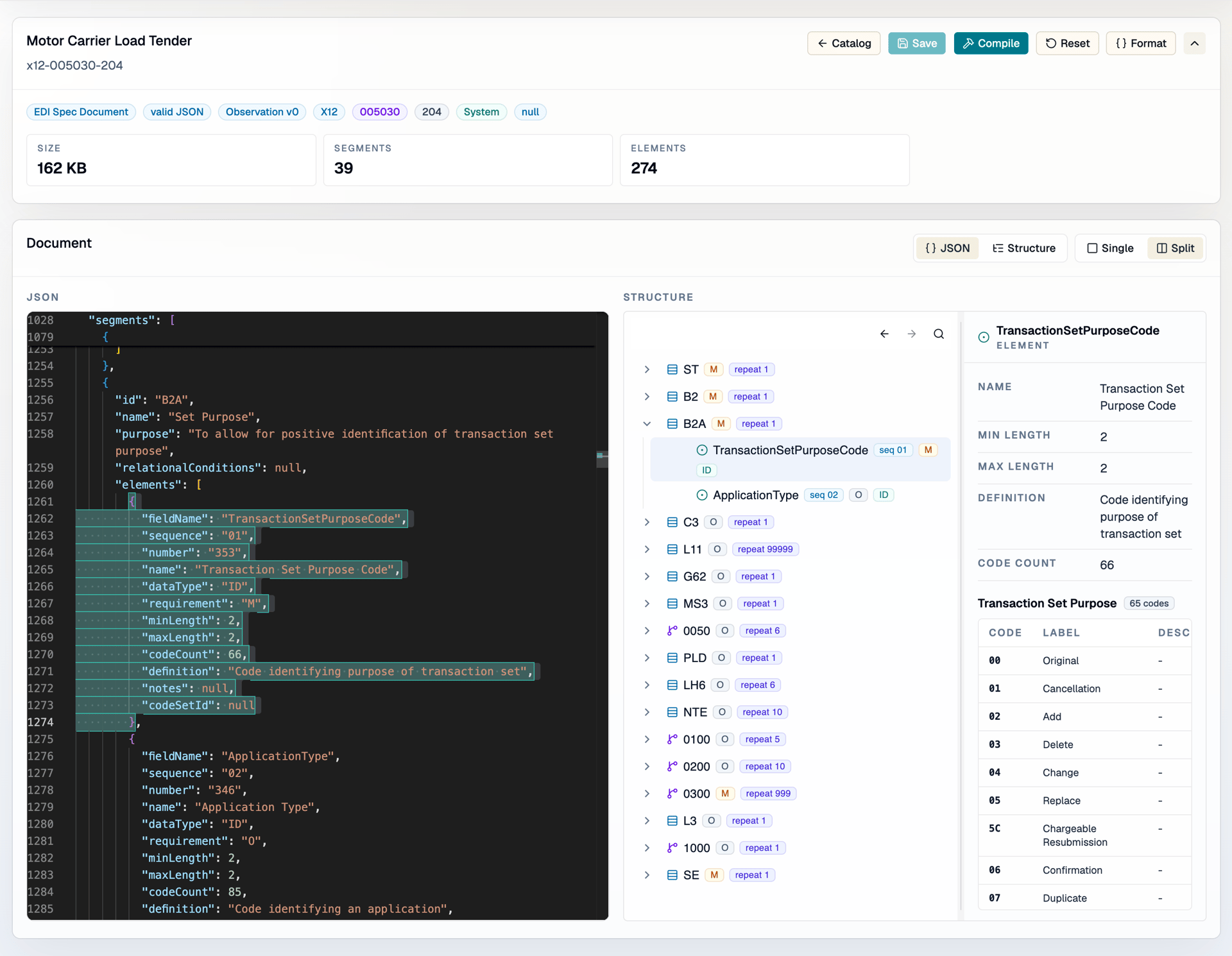
Review is part of inference, not an afterthought. Each accepted, rejected, or edited candidate adds structured evidence about the domain. Experts can also refine concepts, synonym sets, code crosswalks, ontology bindings, and constraints when the proposed relation exposes missing knowledge.
Human-guided learning
Ari captures corrections as structured feedback, then routes them through controlled statistical and semantic learning paths.
An Ari inference run produces ranked relation candidates for human review. Reviewers accept, reject, or edit candidates and add rationale. Ari curates and evaluates that feedback before routing it into two learning paths. The statistical path creates gold mappings, hard negatives, and preference examples, then trains and validates model updates. The semantic path creates governed relations, concepts, and code crosswalks, then versions and publishes semantic assets. Only evaluated model updates and governed asset versions feed later inference runs.
Confirmed mappings can become gold examples and ranking preferences. Rejections can become hard negatives. Semantic corrections improve candidate generation and compatibility checks. Ari evaluates and curates both streams before promoting updates.
Ari turns mapping decisions into reusable semantic assets instead of leaving them inside one-off scripts or spreadsheets.
Versioned source-to-target edges, structural projections, value transformations, and qualifier-dependent mappings.
Concepts, synonyms, roles, and ontology bindings that clarify what fields and structures mean across formats.
Code crosswalks, enumerations, units, identifiers, and other value-level evidence used during matching and validation.
Type, cardinality, hierarchy, mutual-exclusion, and domain constraints that define which candidate combinations are admissible.
Once a relation is confirmed, teams can use the same governed model to drive transformations, validate samples and production payloads, document coverage, compare schema versions, and accelerate related partner or system mappings.
This is especially valuable for EDI modernization and canonical model adoption: one expert decision can improve the current map, become training evidence, and strengthen future inference across related transaction sets and partners.
See where automated relation inference fits and the outcomes it supports.
Examine candidate generation, learned scoring, semantic constraints, and the training data flow.
Review the mathematical model for shapes, evidence, structured scoring, and globally consistent mappings.